The Memorial Cross
The First World War 1914-18 saw the loss of approximately 750,000 British lives.
However, at that time, the government’s official policy was not to repatriate the dead. Thus, to give bereaved families a focal point for their grief, many towns and villages around the UK set about erecting permanent memorials. The names of the fallen were chiselled upon them as a permanent stone tribute: for valour, in honour, in memory and, most importantly, as a reminder, ‘Lest we forget’.
Little Waltham’s residents were amongst those who lost brave young souls during that time. At a village meeting held on January 31st 1917 in the rectory of Little Waltham Church, the Reverend Canon Osbourne William Tancock invited the parishioners to consider the proposal of erecting a War Memorial for those from the village who had fallen.
The meeting gave careful consideration to the fact that the war was still in progress and it was agreed by all that it would be best to wait until the end of the war before providing a worthy, permanent War Memorial. The Reverend stated that until such time, he would keep a Roll of Honour up to date and provide a copy, which he would place inside his window at the vicarage.
It was not until the 5th Feb 1919 that another public meeting was held, again at the proposal of the Rector, who was then joined by the Chairman of the Parish Council. A committee was formed to handle enquiries, obtain subscriptions and report to a later parish meeting. The Rev Tancock was elected as Chairman of the newly formed War Memorial Fund Committee. This meeting heard a proposal put forward by Mr. G Bedford for the memorial to take the form of a Parish Hall. An unqualified estimate of £520 was given for a room of about 50ft by 30ft.
The proposal was seconded by Mr. L.H. Taylor, with additional support from Miss Tancock, Mr. Walter Brown and Mr. Sidney Farnsworth, and the motion was carried. There was also a suggestion that a Y.M.C.A hut could be acquired, but it was not considered suitable as a permanent memorial.
Records of the later meeting, held in June that year, show that, after considering parishioners’ wishes and the expected cost of building a hall, the preference was for a stone cross to be erected. Mr. W S Campen offered to gift a piece of land adjoining the bridge in the village as a site for the cross.
Records also show that, at that time, two pieces of land had been offered by Col. W N Tufnell in relation to the building and placement of the Village Hall. One of those pieces of land was on the road leading to the church, known as Brook Hill.
It appears that the ensuing period was filled with fundraising, obtaining estimates and drawing up designs for both a Memorial Hall and a Memorial Cross. By 22nd October 1919 the fund was reported to have £395 in the bank, with other listed pledges bringing the overall total to £540.
Records of a meeting held in the School Room on Sept 7th 1920 show that Mr. Hicks, the committee secretary, reported £555 in the bank account, with further donations promised which would bring the overall total to £694, 2 shillings and 11 pence. In addition, a cheque for £25 had been promised towards the cost of a cross.
The Rector then proposed accepting Mr. W. Campen’s land donation for the site, but also explained that he could not solicit any specific donations in respect of a cross.
At a meeting on 20th Sept 1921, arrangements were confirmed to erect a cross on the site offered by Mr. Campen. Monies at that time were available from funds that had already been raised for the Memorial Hall and it was agreed that part of those monies could be used.
The final decision was made at a public meeting on 1st November 1921: the design by Messrs. Wray & Fuller of Chelmsford should be approved and an order placed. The cost of the Cross and its stone step was quoted as £102, 5 shillings and 0 pence.
The Memorial Committee then met on 17th Nov 1921, when it was recorded that Messrs. J G Hicks, B. Bird and S. Farnsworth (a special Sub-Committee formed to handle matters relating to a Cross) were empowered to place the order.
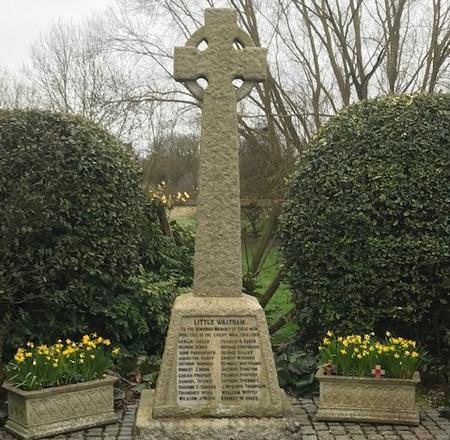
Following its completion, the Memorial Cross was erected at Winkford Bridge, where it stands today.
It was unveiled at a ceremony on 21st May 1922 by Brig Gen J T Wigan and was dedicated by the Rev Canon O W Tancock.
Opening the hall
Raising funds, 1919
Villagers raised money for the proposed hall through subscriptions and entertainment. The Wasps Concert Party performed to a crowded Drill Hall, with songs, comic duets and a sketch called Red Tape. The proceeds went towards the Memorial Hall fund (Essex Weekly News, 7 March 1919).
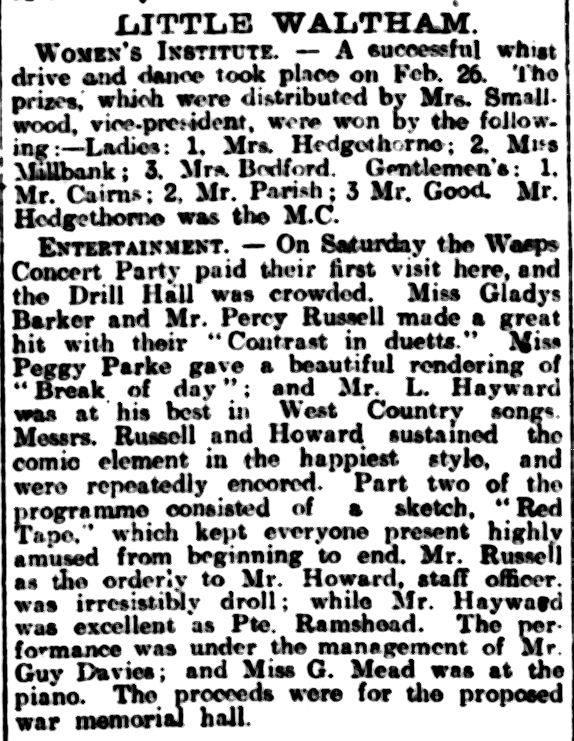
Raising funds for a hall
Essex Weekly News, 7 March 1919, page 6.
The entertainment notice records a concert in aid of the proposed Memorial Hall.
View the full-size clippingRead the 1919 fundraising report
ENTERTAINMENT. — On Saturday the Wasps Concert Party paid their first visit here, and the Drill Hall was crowded. Miss Gladys Barker and Mr. Percy Russell made a great hit with their “Contrast in duetts.” Miss Peggy Parke gave a beautiful rendering of “Break of day”; and Mr. L. Hayward was at his best in West Country songs. Messrs. Russell and Howard sustained the comic element in the happiest style, and were repeatedly encored. Part two of the programme consisted of the sketch, “Red Tape,” which kept everyone present highly amused from beginning to end. Mr. Russell as the orderly to Mr. Howard, staff officer, was irresistibly droll; while Mr. Hayward was excellent as Pte. Ramshead. The performance was under the management of Mr. Guy Davies; and Miss G. Mead was at the piano. The proceeds were for the proposed war memorial hall.
The opening gathering, 1924
The hall opened on 18 June 1924 (Summer 2024 parish magazine, page 2). The celebrations began with the National Anthem and music from an orchestra conducted by J. R. Young of Chelmsford. Colonel Ridley described the occasion as a friendly gathering. Songs, instrumental solos, recitations and sketches by the Little Waltham Dramatic Society followed (Chelmsford Chronicle, 27 June 1924).
Some residents had favoured a memorial cross. In the end, the village provided both a cross and a hall in memory of those lost in the Great War. Colonel Ridley hoped that villagers would use the hall for social occasions and make friends there.
By then, £782 10s. 2d. had been received for the hall, alongside £140 6s. 4d. for the cross. Honorary secretary Sidney Farnsworth and honorary treasurer F. G. Hicks were thanked for their work and presented with a blotter and a silver inkpot respectively.
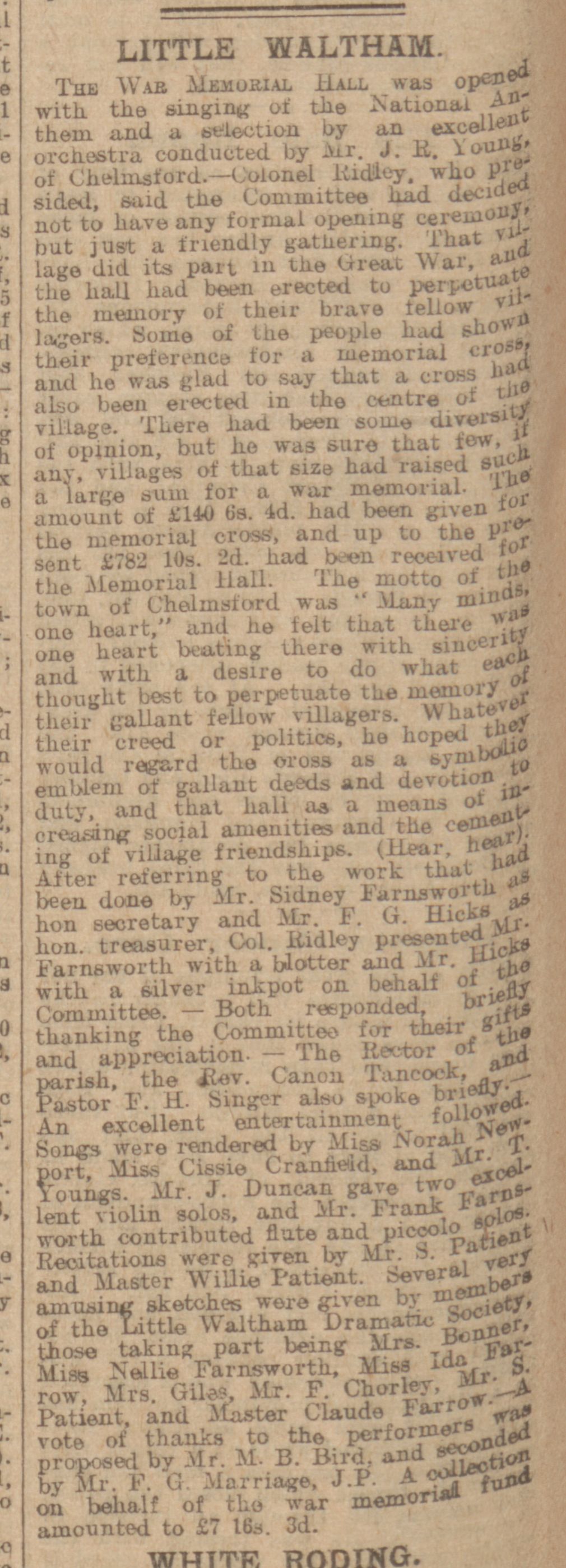
The hall opens
Chelmsford Chronicle, 27 June 1924, page 6.
An account of the opening celebrations and the committee’s work.
View the full-size clippingRead the 1924 opening report
THE WAR MEMORIAL HALL was opened with the singing of the National Anthem and a selection by an excellent orchestra conducted by Mr. J. R. Young, of Chelmsford.—
Colonel Ridley, who presided, said the Committee had decided not to have any formal opening ceremony, but just a friendly gathering. That village did its part in the Great War, and the hall had been erected to perpetuate the memory of their brave fellow villagers. Some of the people had shown their preference for a memorial cross, and he was glad to say that a cross had also been erected in the centre of the village. There had been some diversity of opinion, but he was sure that few, if any, villages of that size had raised such a large sum for a war memorial. The amount of £140 6s. 4d. had been given for the memorial cross, and up to the present £782 10s. 2d. had been received for the Memorial Hall. The motto of the town of Chelmsford was “Many minds, one heart,” and he felt that there was one heart beating there with sincerity and with a desire to do what each thought best to perpetuate the memory of their gallant fellow-villagers. Whatever their creed or politics, he hoped they would regard the cross as a symbolical emblem of gallant deeds and devotion to duty, and that hall as a means of increasing social amenities and the cementing of village friendships. (Hear, hear).
After referring to the work that had been done by Mr. Sidney Farnsworth as hon. secretary and Mr. F. G. Hicks as hon. treasurer, Col. Ridley presented Mr. Farnsworth with a blotter and Mr. Hicks with a silver inkpot on behalf of the Committee.—
Both responded, briefly thanking the Committee for their gifts and appreciation.—
The Rector of the parish, the Rev. Canon Tancock, and Pastor F. H. Singer also spoke briefly.—
An excellent entertainment followed. Songs were rendered by Miss Norah Newport, Miss Cissie Cranfield, and Mr. T. Youngs. Mr. J. Duncan gave two excellent violin solos, and Mr. Frank Farnsworth contributed flute and piccolo solos. Recitations were given by Mr. S. Patient and Master Willie Patient. Several very amusing sketches were given by members of the Little Waltham Dramatic Society, those taking part being Mrs. Bonner, Miss Nellie Farnsworth, Miss Ida Farrow, Mrs. Gilas [reading uncertain], Mr. F. Chorley, Mr. S. Patient, and Master Claude Farrow.—
A vote of thanks to the performers was proposed by Mr. M. B. Bird, and seconded by Mr. F. G. Marriage, J.P. A collection on behalf of the war memorial fund amounted to £7 16s. 3d.
The early years
In May 1925, the War Memorial Committee offered the building and its site to the Parish Council. Chairman M. B. Bird recommended that the council accept the offer. He explained that a bank loan covered the outstanding balance. Four parishioners had guaranteed the loan and would remain responsible for it (Chelmsford Chronicle, 8 May 1925).
Sidney Farnsworth reported that letting fees had brought in more than £10 since the hall opened. It had been used less than the committee had hoped, but he said it was paying its way. The council voted against accepting the offer by four votes to two, then unanimously asked the committee to offer the hall again in six months.
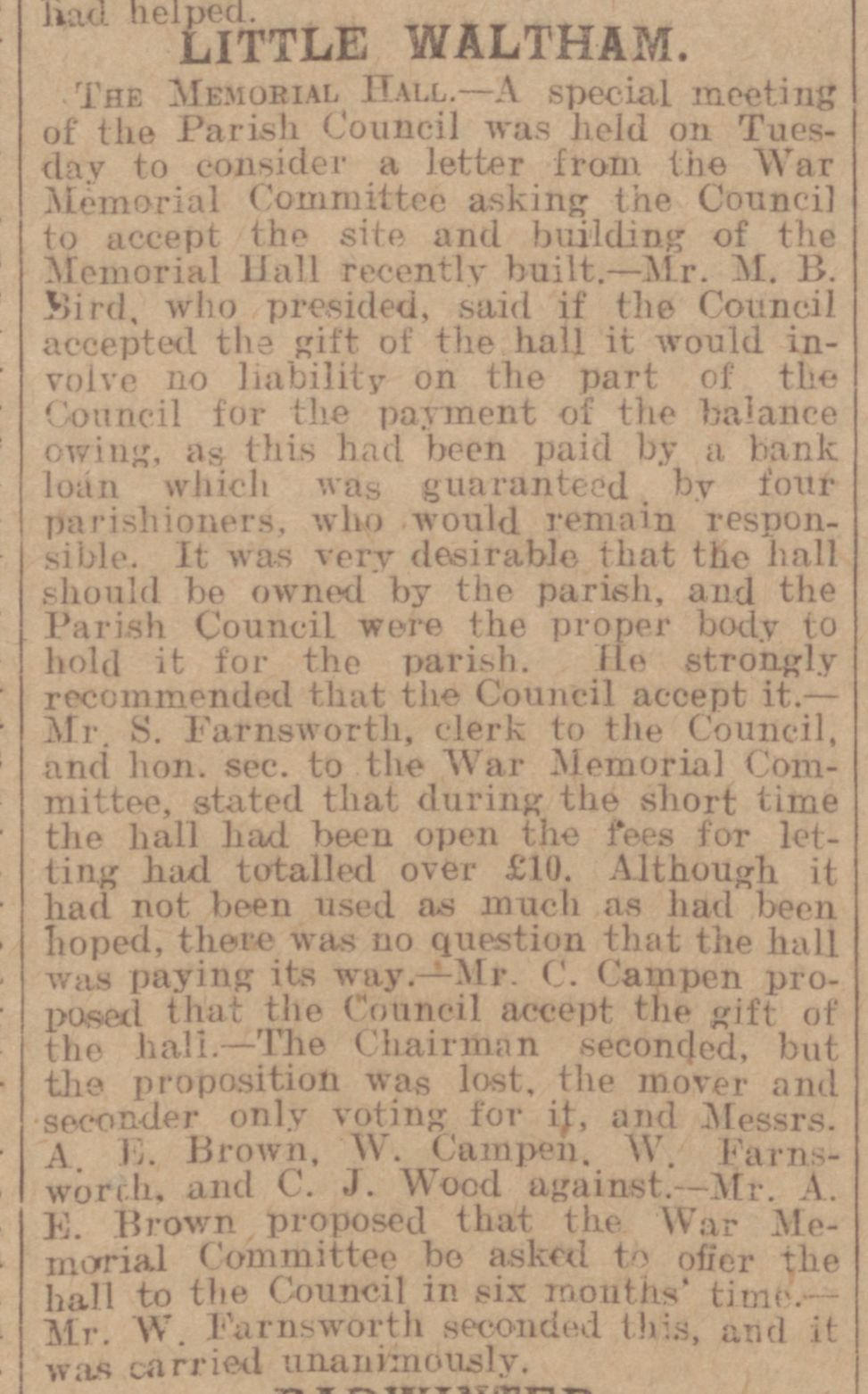
The offer to the Parish Council
Chelmsford Chronicle, 8 May 1925, page
12.
A contemporary account of the hall’s early finances and a proposed transfer of the building and site.
View the full-size clippingRead the 1925 council report
THE MEMORIAL HALL.—
A special meeting of the Parish Council was held on Tuesday to consider a letter from the War Memorial Committee asking the Council to accept the site and building of the Memorial Hall recently built.—
Mr. M. B. Bird, who presided, said if the Council accepted the gift of the hall it would involve no liability on the part of the Council for the payment of the balance owing, as this had been paid by a bank loan which was guaranteed by four parishioners, who would remain responsible. It was very desirable that the hall should be owned by the parish, and the Parish Council were the proper body to hold it for the parish. He strongly recommended that the Council accept it.—
Mr. S. Farnsworth, clerk to the Council and hon. sec. of the War Memorial Committee, stated that during the short time the hall had been open the fees for letting had totalled over £10. Although it had not been used as much as had been hoped, there was no question that the hall was paying its way.—
Mr. C. Campen proposed that the Council accept the gift of the hall.—
The Chairman seconded, but the proposition was lost, the mover and seconder only voting for it, and Messrs. A. E. Brown, W. Campen, W. Farnsworth, and C. J. Wood against.—
Mr. A. E. Brown proposed that the War Memorial Committee be asked to offer the hall to the Council in six months’ time.—
Mr. W. Farnsworth seconded this, and it was carried unanimously.
Village activities
Concerts, theatre and lectures
The ’Stute Follies Concert Party performed songs, humorous duets and a burlesque at the hall (Chelmsford Chronicle, 13 March 1925).
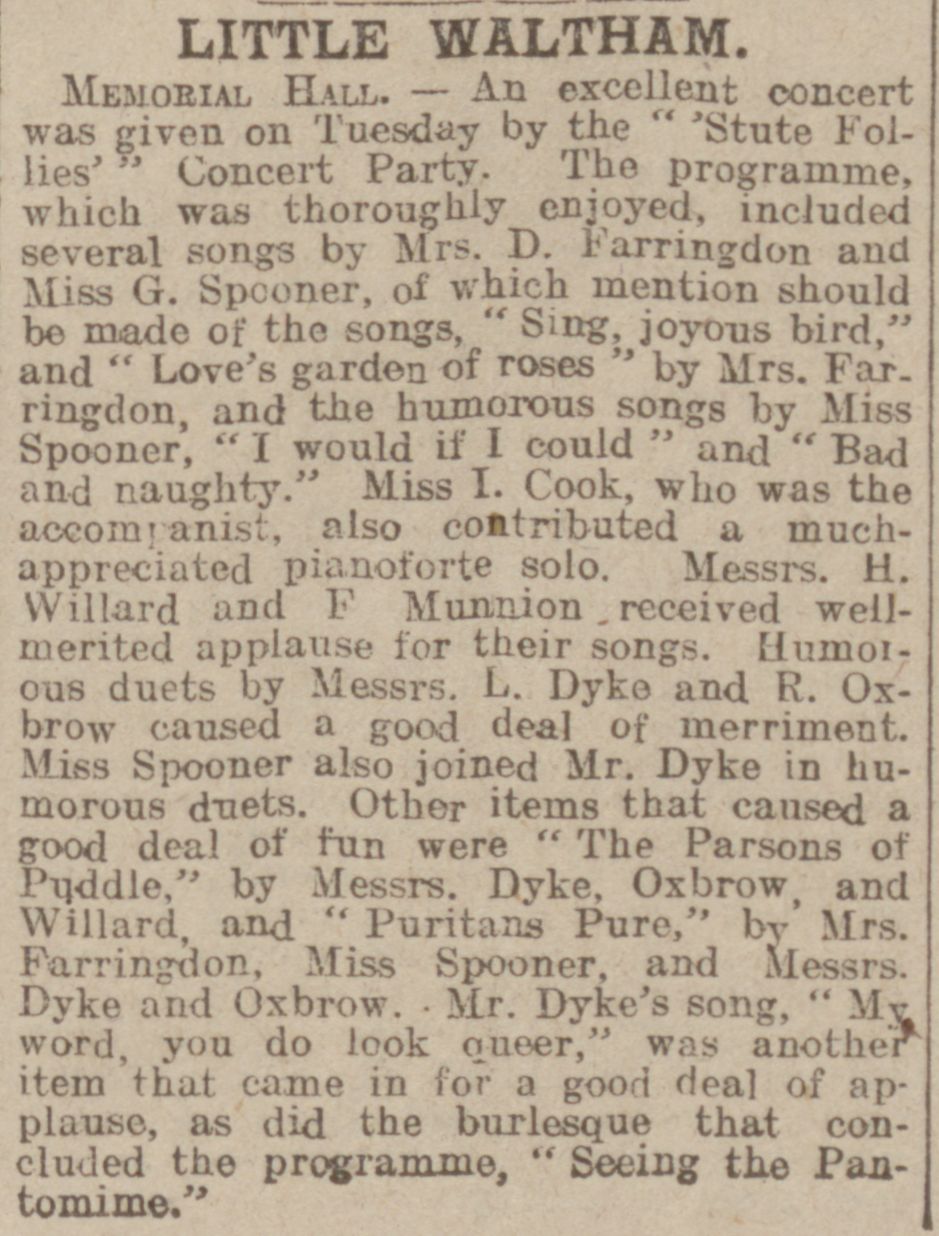
In December 1934, a lecture on Sir Evelyn Wood took place as part of the Famous Men of Essex series. The Little Waltham Players also arranged a social evening at the hall that month. Despite wet weather, attendance was close to a record. The Players hoped to use the proceeds to help pay for costumes for a nativity play (Chelmsford Chronicle, 21 December 1934).
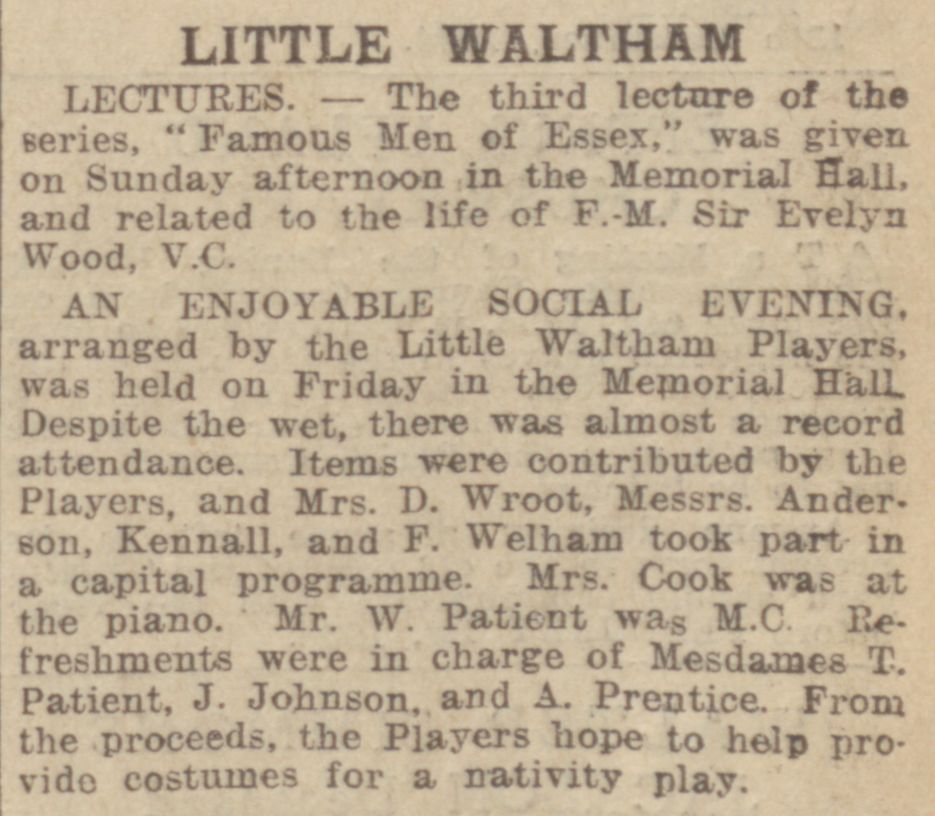
Lectures and a Players’ evening
Chelmsford Chronicle, 21 December 1934,
page 5.
Two notices show the hall being used for learning, entertainment and fundraising.
View the full-size clippingRead the 1934 notices
LECTURES.—
The third lecture of the series, “Famous Men of Essex,” was given on Sunday afternoon in the Memorial Hall, and related to the life of F.-M. Sir Evelyn Wood, V.C.
AN ENJOYABLE SOCIAL EVENING, arranged by the Little Waltham Players, was held on Friday in the Memorial Hall. Despite the wet, there was almost a record attendance. Items were contributed by the Players, and Mrs. D. Wroot, Messrs. Anderson, Kendall, and F. Welham took part in a capital programme. Mrs. Cook was at the piano. Mr. W. Patient was M.C. Refreshments were in charge of Mesdames T. Patient, J. Johnson, and A. Prentice. From the proceeds, the Players hope to help provide costumes for a nativity play.
Tea for visiting bellringers, 1936
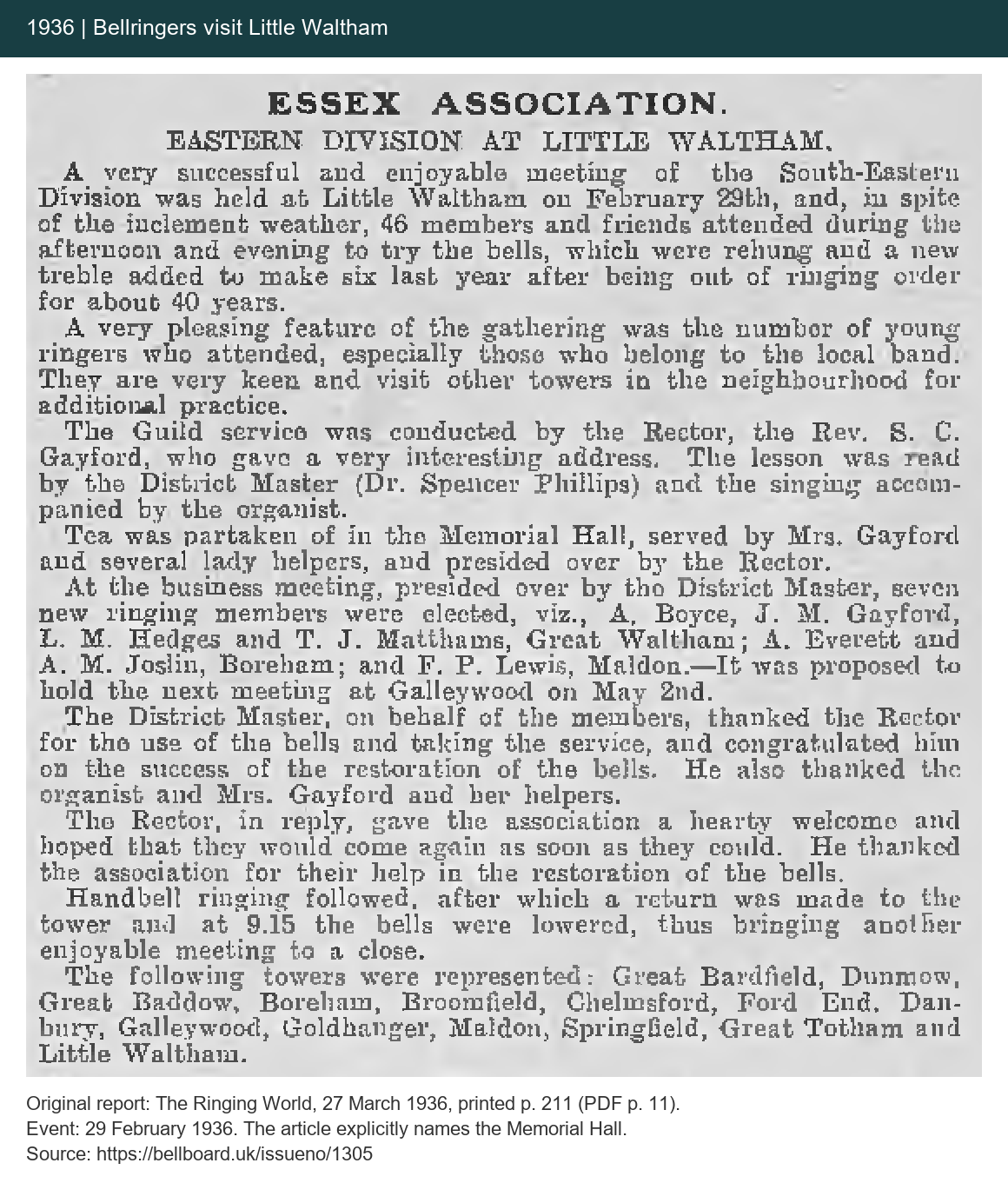
On 29 February 1936, 46 members and friends of the Essex Association’s South-Eastern Division visited Little Waltham despite bad weather. Mrs Gayford and other helpers served tea in the Memorial Hall. After a business meeting and handbell ringing, the visitors returned to the church tower (The Ringing World, 27 March 1936, page 211).
Joan Weston’s dancing school, 1939
Joan Weston, formerly a dancer with the Paris Opéra, started her dancing school in Little Waltham Memorial Hall in 1939. She later founded the Chelmsford Ballet Company (Weston School history).
The Roll of Honour
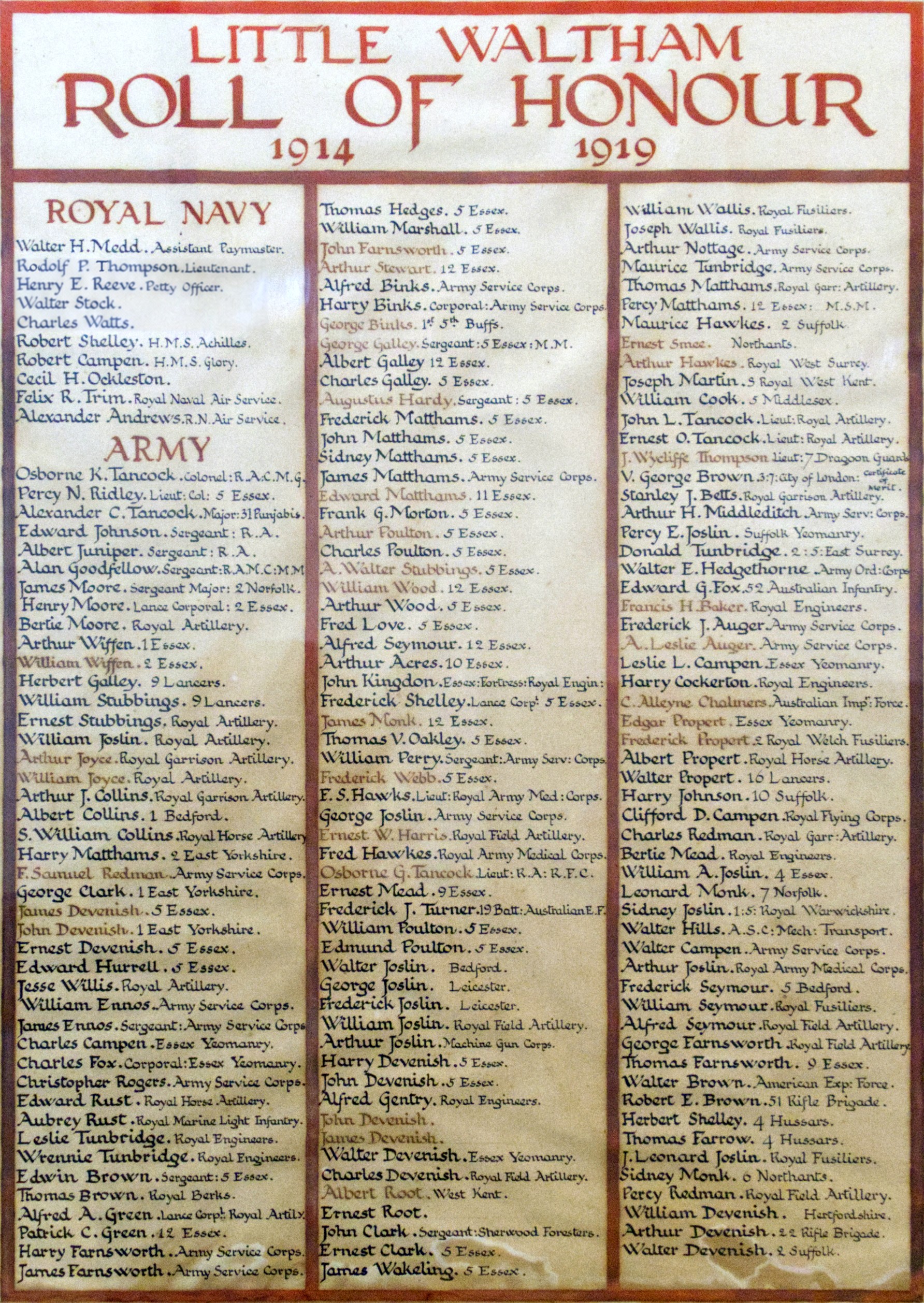
A Roll of Honour hangs in the main hall of our building.
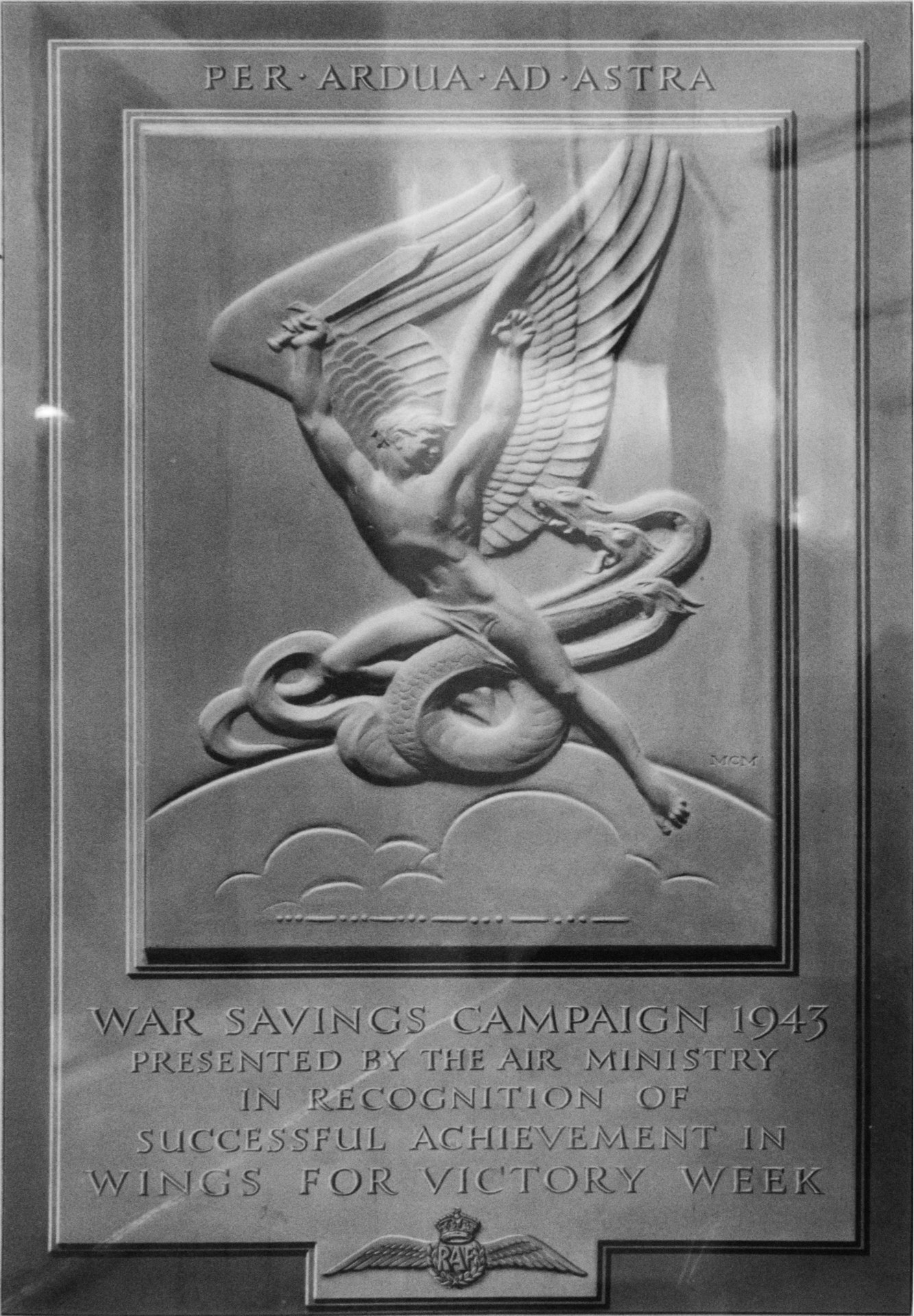
Wings for Victory Week, 1943
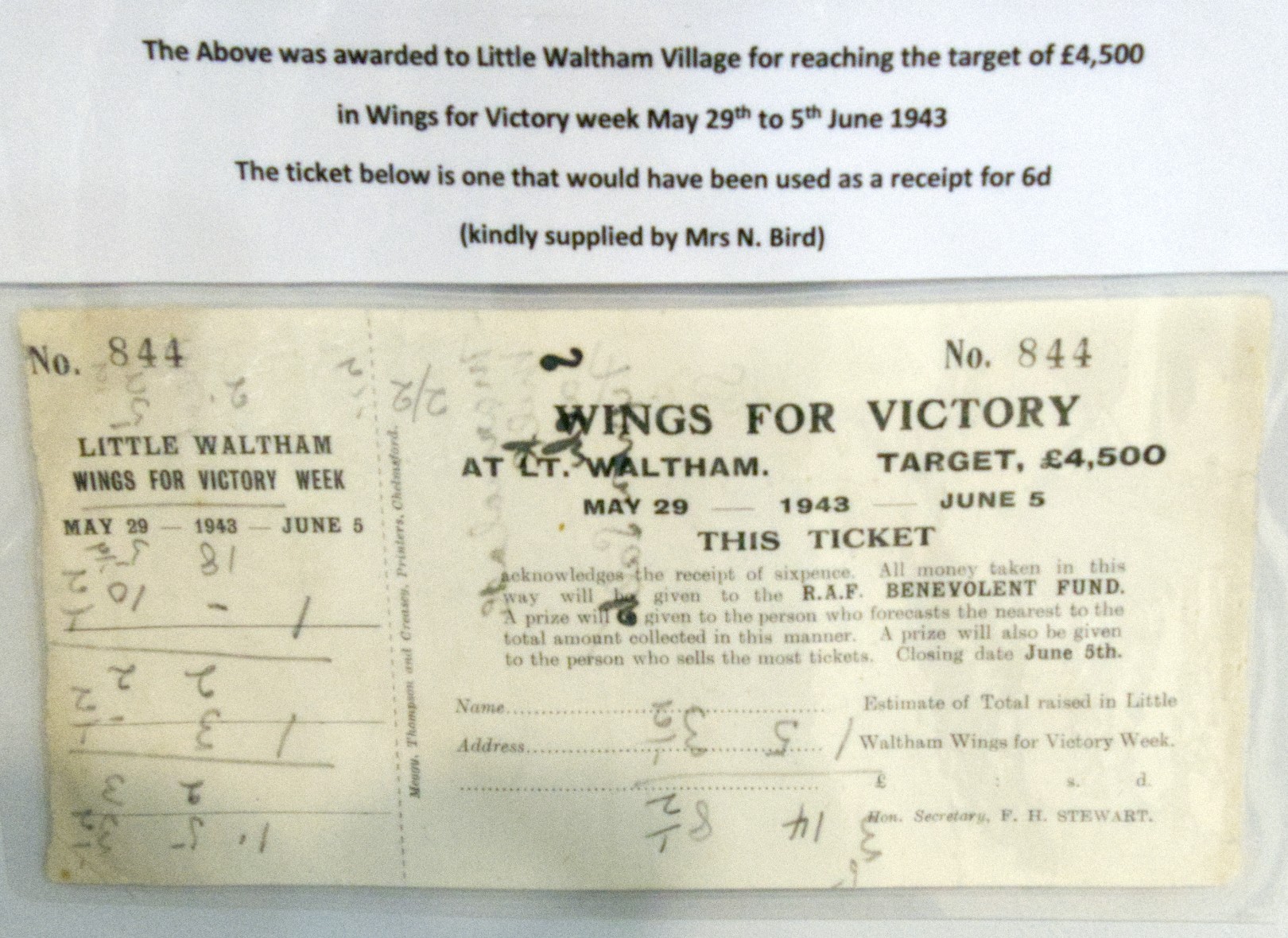
The accompanying display records that Little Waltham reached its £4,500 target during Wings for Victory Week, held from 29 May to 5 June 1943. The Air Ministry presented this plaque in recognition of that achievement.
The ticket below, kindly supplied by Mrs N. Bird, acknowledges receipt of sixpence (6d). It states that money collected through these tickets would go to the RAF Benevolent Fund. Prizes were offered for the nearest estimate of the total collected and for the person who sold the most tickets.